



Rodent Information, Prevention & Treatment
Overview
Domestic rodents, also called commensal rodents, are three species of rats and mice which live in close contact with man. Damage caused by these animals is varied and extensive with losses reaching millions of dollars annually. They are found almost everywhere that man dwells. They inhabit man’s buildings and destroy his food and property.
Rodents damage buildings by gnawing at doors, window casings or almost any point where entry is attempted. Gnawing damage is also serious on-board ships and planes, where numerous cables, communication and navigation systems, water-tight compartment gaskets, food lockers and other materials are susceptible to damage.
Norway rats burrowing under building foundations, walks, driveways and streets frequently cause stress cracks and breaks. Paper and wood merchandise containers are attractive to rats. Feed contaminated by feces and urine is an economic loss to the owner and a health hazard to livestock.
Commensal rodents are responsible for many diseases affecting public health. Murine typhus fever and plague are the most important, although salmonellosis, trichinosis, leptospirosis and rat-bite fever also are transmitted.
Besides being threats to human health, rats distribute many diseases to livestock, poultry and pets. Examples are brucellosis, distemper, leptospirosis trichinosis, equine influenza, mange, mastitis, swine erysipelas, tracheitis and tuberculosis.
Rodent Identification
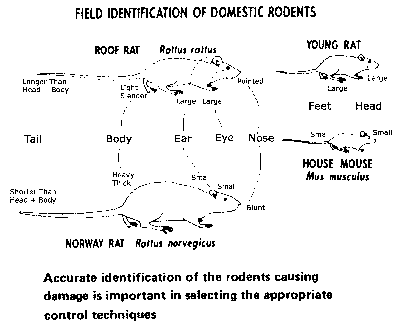
Commensal rodents are not native to North America but came with European settlers. The three species – the Norway rat, house mouse and roof rat – physically differ in many ways and are identified easily. Important differences between species affect control programs.
The three commensal rodents may be separated from native rodents by the character of their tails. Tails of commensal rodents are scaly and sparsely covered with hair; tails of native rodents have more hair and smaller scales. Fur color varies widely among rodents, even between individuals of the same species. Therefore, color alone is not a good identifying characteristic.
Field identification characteristics include relative length of tail and size of body and ears. A roof rat’s tail usually is longer than its head and body. When the tail is stretched over the back it extends past the nose. The Norway rat’s tail, however, does not extend past its nose when stretched over Its back. A roof rat’s ears also are large and conspicuous.
The roof rat’s eyes are larger and set farther forward than the Norway rat’s. The Norway rat’s body is heavier and stockier when compared with the roof rat which has a pointed muzzle and a slim body. Juvenile rats are distinguished from adult house mice by their larger feet, heads and tails.
Senses, Agility and Reaction of Rodents
Knowledge of the senses, agility and reactions of rats and mice is important in planning rat-proofing and deterring sources of rodent entry into infested structures. However, knowledge of movement is much less important than knowledge of reproduction and survival in attacking a rodent population.
Touch is well developed in highly sensitive whiskers or vibrissae and certain guard (tactile) hairs. Rats and mice prefer to run along walls or between things where they can keep their whiskers in contact with side surfaces.
Vision is not too well developed. Apparently they are color blind, so any distinctive coloring of poison baits does not reduce their acceptance by rats.
Smell is keen. Rodents apparently like the odors of most foods eaten by man. They are accustomed to the smell of man, so his odor on baits and traps not repel them.
Taste is not as sensitive as in man. Rats associate sickness caused by poison bait with the bait and not the poison. They prefer fresh food to decayed food.
Hearing is keenly developed. They can locate the source of a noise within 6 inches. Unusual noises cause rodents to attempt escape.
Balance is excellent. A falling rodent always lands on its feet. The roof rat even maintains its balance well while walking on suspended wires.
Reaction to strange objects. Rats may avoid a new sound or a strange object in their environment for 3 or more days, particularly if their associates are alarmed by it. Other objects are accepted readily by them (i.e., food and garbage). As rodent population pressures build, rats frequently exhibit “chain-fright reaction” to disturbances. Mice are more likely to explore new objects and to be caught in newly set traps.
Climbing Roof rats and house mice are good climbers, and the Norway rat can climb quite well when necessary.
Jumping and reaching Rats can jump nearly 2 feet vertically, 3 feet from a running start; they can jump 4 feet horizontally, and 8 feet from an elevation 15 feet above the finish point. Rats can reach upward about 18 inches.
Swimming Rodents are good swimmers. They are able to swim up through floor drains and toilet bowl traps.
Recognizing Rat and Mouse Signs
Rats and mice are habitually nocturnal and secretive and are rarely seen during the day except when infestations are heavy. Therefore, to plan control work, it is necessary to properly interpret signs of their activities. These signs are found in secluded places, such as along walls, under piles of rubbish and behind or under boxes, boards and thick vegetation. From the rodent signs, one can tell the species present and whether a rodent infestation is current or old, heavy or light.
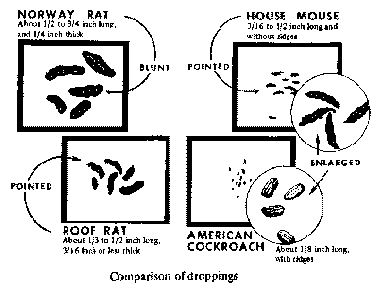 Droppings Fresh droppings of feces usually are moist, soft, shiny and dark, but in a few days they become dry and hard. Old droppings are dull and grayish and crumble when pressed with a stick. The roof rat’s droppings are up to 1/2 inch long, spindle shaped and curved in contrast to Norway rat droppings which are about the same length but comparatively blunt. Mouse feces are small, Averaging about 1/8 inch long, and are pointed on both ends.
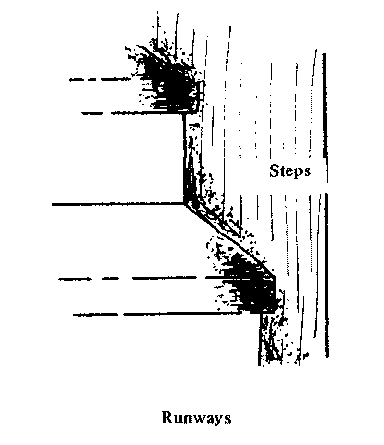 Runways Rats habitually use the same runways between food, water and harborage. Because of the keenly developed sense of touch in their vibrissae (whiskers) and in specialized hairs along the body, rats prefer continual body contact with at least one vertical surface such as a fence or wall. Rats also follow “odor trails.” Outdoors, their runways are narrow pathways of beaten earth swept clear of debris. Indoors, greasy runways are found along walls, steps and rafters. Undisturbed cobwebs and dust in a runway indicate that it is not in use.
Rubmarks Along regularly traveled runways, a dark, greasy mark forms from contact with the rodent’s body. Fresh marks are soft and smear if rubbed. As the grease ages, it dries, gathers dust and flakes off when scratched with a fingernail. Rubmarks of the Norway rat are most commonly seen overhead as swing marks beneath beams or rafters where they connect to the walls. Mice do not have detectable rubmarks except when the infestation is heavy.
Burrows The Norway rat prefers burrows for nesting and harborage; the roof rat burrows only occasionally. Burrows are found in earth banks, along walls, under rubbish or concrete slabs and in similar places. If a burrow is in use, its entrance is free of cobwebs and dust. Fresh rubmarks on hardpacked soil at the opening indicate a well established and presently used burrow. Fresh fragments of food or freshly dug earth at these burrow entrances also current use by rats.
Gnawings The incisor teeth of rats grow 4 to 5 Inches a year, so these rodents must do some gnawing each day to keep their teeth short enough to use. Rats also gnaw to gain entrance and to obtain food. When gnawings in wood are fresh, they are light colored and show distinct teeth marks. Small chips of wood or other materials indicate recent gnawing. With age, wood gnawings become dark and smooth from weathering and from frequent contact with the rodent’s body.
Tracks Fresh tracks are sharp and distinct, whereas old tracks are covered with dust and are less distinct. Tracks of the five-toed rear paws are more commonly observed than are those of the four-toed front paws, but both may be present. Smooth patches of any dust material, such as flour or talc, placed along runways are valuable for checking rodent activity. To see tracks in the dust, hold a flashlight at an angle where tracks cast distinct shadows. Tail marks, too, are often visible in dust or tracking patches.
Urine Dried rodent urine will fluoresce bluish white to yellowish white. Commercial black lights often are used to detect rodent urine, however observing fluorescence is not a guarantee that rodent urine is present. Numerous items will fluoresce under a black light, including optical bleaches found in many detergents and lubricating oil. For positive identification use a Brom Thymol Blue Urease Test. Place the suspected material on Urease-Brom Thymol-Blue test paper. Moisten with water and cover with a glass. If a bluish spot appears after 3 to 5 minutes, it is rodent urine.
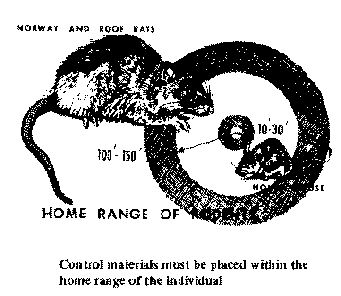 Home range Rats and mice usually spend their lives in a very limited area called their home range, which is no larger than necessary to provide the necessities of life (food, cover and water). An individual moves from its home range only when necessary. Under favorable conditions home range might be less than 10 feet in diameter; under less favorable conditions it may be up to 150 feet. Rats generally range further than mice. This information affects placement of a rodenticide bait station or traps within the home range of an individual.
Sounds Gnawing, clawing, climbing in walls, squeaks and fighting noises may be heard.
Visual sighting Observation of rats in daylight generally Indicates a high or moderately high population in the area. Night observations with a powerful flashlight or spotlight often are helpful.
Nests and food caches These can sometimes be found when cleaning garages, attics, basements, closets and other storage places. Roof rats, as well as other rodent species (i.e., squirrels and packrats), often store food in attics. Roof rat nests may be exposed when dense vegetation is pruned or removed from an infested area.
Rat odors Rat odors in a room may provide a clue to their presence. With a little experience, the odors of house mice (Mus musculue) can be differentiated readily from those of rats.
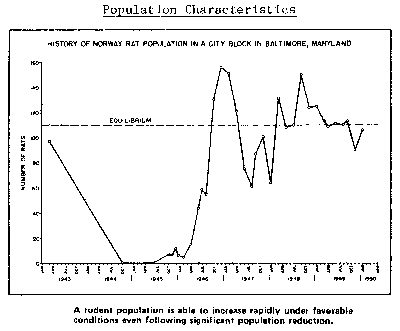 Rodent Population Characteristics
Rats and mice have extremely high reproductive potential. Factors affecting rat populations are age at puberty of 6 to 11 weeks, a year-round breeding season and an estrous cycle of 4 to 6 days.
Other reproductive factors include a gestation period of approximately 21 days, an average litter size of eight (four to twenty) and two to four litters per year.
All these factors indicate why a rodent population increases so rapidly under favorable conditions.
It has been demonstrated repeatedly that when nothing is done to eliminate the food source or available shelter after rats or mice have been controlled in a given area, populations soon recover because of increased birth and rearing success. Conversely, rodents living in an environment of limited food and shelter reproduce at a slower rate.
Three population forces determine the size of a rodent population at any given time. These are reproduction, mortality and movements.
Reproduction increases the population; mortality makes it smaller and movement work in either direction. The relative balance of these population forces determines whether a population is growing, shrinking or staying the same.
Rodent Treatment
Overview To plan a specific program, thoroughly survey the area to be treated. This should determine location and severity of rat-infested areas, major sources of rodent food and shelter, species of rat involved and other data pertinent to local conditions. Some toxicants are selective and differ in effectiveness between the three species. Baits also have varying degrees of attractiveness to the species. Behavioral differences also Influence the effectiveness of traps and trap placement. Thus, species identification is an essential first step in a program of control.
Poisoning should precede any extensive cleanup or environmental control, since rats migrate quickly when food and shelter are removed and create problems at other locations. While the emphasis on any single phase of rodent control varies with the building structure, location and species of rodent involved, an effective control program should start with keeping rodents out and establishing or maintaining a high sanitation level.
Exclusion Whenever possible, exclude rodents from dwellings, apartments, houses and other buildings by making every opening in outer walls, at floor/wall junctions and at all exterior doors tight enough to prevent rodent entry, and by installing guards across runways to prevent entry through doors. There should be no openings larger than 1/4 inch.
Materials that can be used for rat proofing are: Galvanized sheet metal 26-gauge or heavier Galvanized or rustproof expanded metal 28-gauge or heavier; mesh openings no larger than 1/4 inch Perforated metal 24-gauge or heavier; perforations no larger than 1/4 inch Iron grills As heavy as above materials, slots no larger than 1/4 inch > Galvanized or rustproof hardware cloth 19-gauge or heavier; opening no larger than 1/4 inch Cement mortar 1:3 mixture or richer
Sanitation Proper control of solid waste is the key to upgrading environmental quality. As neighborhoods decay building owners often move away, lose value and the absentee, or resident, owners cease investing in the properties. Rubbish may accumulate, garbage may be picked up less frequently and residents become more careless in their sanitation practices. This attitude, whether practiced at home or at a business establishment, could lead to rat infestation in entire
Baiting and Trapping Effective rodent control depends on a number of factors, including identification of the pest and the problem, knowledge of rodent biology and habits, an estimate of population levels, evaluation of the impact on public health and the control measures available. Eliminating the conditions causing rodent infestations is paramount in solving the problem; however, these methods often are slow and time-consuming. Poison baits and traps are used to reduce large populations quickly, maintain continuing programs and eliminate a small number of nuisance rodents.
Baits and Baiting All rodenticides are not equally appropriate for a given situation. Consider rodenticide characteristics such as the size of a lethal dose, acceptability, odor, taste, stability in baits, solubility, compatibility with baits and type and degree of hazards.
Anticoagulants are poisons which slow blood clotting, causing animals to bleed to death. They may be placed in water bait. Their inherent safety has made them a major means of commercial rodent control. Because anticoagulants are a slow acting, multidose poison, hazards associated with their use are lessened. However, more bait and more time are required before control is achieved. Anticoagulant baits may be used in bait stations or toss-type packets.
Conditions may dictate the choice of a single-dose poison. Use hazards are greater than for anticoagulants which call for additional safety precautions, proper placement of bait and use of tamper-proof bait boxes are necessary. Highly toxic bait should be consumed in the bait box.
To prevent possible hazards, keep bait small to avoid its being carried back to rat nests. Low toxicity baits may be placed outside of the bait boxes. Rats are omnivorous and eat almost any kind of food available. However, because of taste and/or nutrient requirements, they show food preferences. Selecting proper bait materials is important. Ingredients used for making rat baits should be compatible with the selected toxicant, and more importantly, readily accepted by rats. Bait must be as good or better than the rat’s local food source.
Norway rats accept cereals, nuts, fruits, vegetables, meats and fish, but roof rats do not readily eat meats or fish. Often a change in the kind of food offered produces the greatest success, although rats occasionally refuse is to touch a food they are not accustomed to eating. Since rats are color blind, poison bait may be colored with a warning dye.
Commercial baits are available in several forms such as granular, cereal, oil based bait, paraffinized bait pellets or paraffin-impregnated bait blocks. Some rodenticides are available only in the technical form and must be diluted and combined with a bait food.
Trapping Relying entirely on bait stations and fumigants for rodent control does not produce desired results. It is necessary to kill rodents quickly upon entry into a building, therefore, use traps. Effective trapping of commensal rodents depends on several factors. The most important is an understanding of rodents basic traits. Norway rats, while as agile as tree squirrels when necessary, are more at home on the ground and normally are caught there. Roof rats are fond of climbing and are taken more frequently from their runs along pipes and supporting beams. Habits of mice vary somewhat from the other two types of rodents. They are much more inquisitive and explore their environment continually. It is this drive that causes a mouse to investigate a newly placed trap, whereas a rat is apt to avoid it because of the well-known “new object reaction. For this reason, leave rat traps in place longer than mouse traps.